
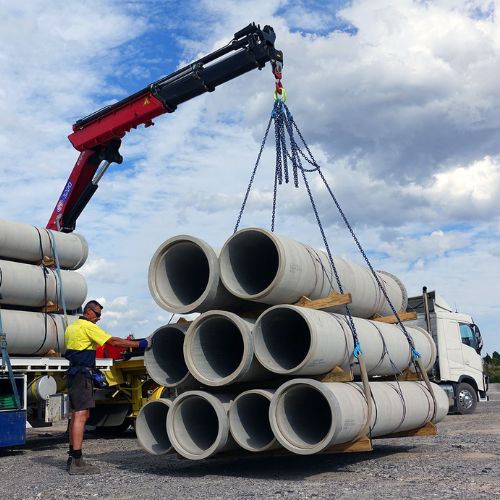
Most buyers shopping for a vehicle loading crane start with a weight, but crane specifications don’t work that way. Tonne-metre ™ is the rating that actually tells you what a crane can do, because it accounts for both the weight of the load and how far from the crane you need to lift it. A crane rated at 6 tonne-metres can theoretically lift 2 tonnes at 3 metres, 3 tonnes at 2 metres, or 1 tonne at 6 metres. Getting the tonne-metre calculation right is how you shortlist the right vehicle loading crane, stay on the right side of Australian licensing requirements, and avoid paying for capacity you don’t need or, worse, not having enough when it counts.
What Is Tonne-Metre?
Tonne-metre is a measure of load moment, the combined effect of weight and reach distance, not simply weight. The formula is straightforward:
Tonne-Metre = Load Weight (tonnes) × Reach Distance (metres)
Lifting 2 tonnes at 4 metres from the centre of the column is theoretically an 8 tm operation. The same crane could theoretically lift 4 tonnes at 2 metres, or 1 tonne at 8 metres. In practice, real-world capacity is always slightly less, because the self-weight of the crane and its components must be subtracted from the rated load. The rating describes the theoretical relationship between weight and distance — your actual payload capacity will be a little lower.
| Load (tonnes) | Reach (metres) | Tonne-Metre Rating |
| 2 | 4 | 8 tm |
| 1 | 8 | 8 tm |
| 4 | 2 | 8 tm |
This is why a raw tonnage figure isn’t enough to select a vehicle loading crane. Two cranes might both lift 2 tonnes, but if one lifts at 3 metres and the other at 6, they have very different tonne-metre ratings and capabilities on the job.
How to Calculate the Tonne-Metre Rating You Need
To calculate your minimum tonne-metre requirement, you need two numbers: the maximum weight you’ll lift in tonnes and the maximum reach in metres, measured from the centre of the column. Multiply one by the other, and that’s your baseline.
The catch is that the real-world number is often higher than the one on paper. Tall or bulky loads are a good example. When a load is high or the sling is long, the crane may not be able to use its inner boom effectively during the lifting setup, which increases the effective load radius and reduces the available lifting capacity.
A job that calculates as 6 tm in theory may need an 8 tm crane once the actual boom geometry is accounted for. Reach is the other common miscalculation. Buyers often measure from the truck edge rather than the centre of the column where the crane is mounted, and that difference alone can push the requirement into a higher tonne-metre class.
For both reasons, building in a 10–20% buffer above your calculated minimum is worth it. If your operation regularly involves lifts near the crane’s rated maximum, sizing up a class reduces wear, improves safety margins, and gives you capacity for the jobs that don’t fit the formula neatly.
Why Tonne-Metre Matters for Licensing in Australia
In Australia, the 10 tonne-metre threshold marks the point at which licensing requirements change. For cranes below 10 tm, operators must be trained and competent to operate the crane safely, but a High Risk Work Licence is not required. Training pathways can vary by state, territory and industry. RIIHAN307E is a relevant unit, but it does not, in itself, provide a licence.
At 10 tm or above, a High Risk Work Licence applies. Because crane licence rules are being updated and regulator guidance is not yet fully uniform across jurisdictions, operators should confirm the current licence class required with their state or territory regulator before operating.
The important thing to know is how to check whether a crane actually crosses that 10 tm line. The answer is on the crane’s load chart, not just in the model name. If, at any position on the load chart, the radius in metres multiplied by the load in tonnes equals or exceeds 10, the crane is treated as 10 metre tonnes or more for licensing purposes. Some jurisdictions may also have additional plant registration requirements, so it is worth checking the relevant regulator before purchase or operation.
Reading a Crane Load Chart
Every vehicle loading crane has a load chart that shows the crane’s capacity at different boom lengths, boom angles, and extensions. This is the document that tells you exactly what the crane can lift at the specific reach required for your job, not just its overall tonne-metre category.
The key relationship on any load chart is between boom reach and load capacity. At shorter reach with a steep boom angle, the crane operates near its maximum rated capacity. As the boom extends further, that capacity drops. A crane’s tonne-metre rating gives you the broad category for shortlisting, but the load chart gives you the precision for planning an actual lift at a specific radius and boom configuration.
Tonne-Metre Ranges: What Does Each Class Handle?
For simplicity, this guide groups vehicle loading cranes into three practical buying ranges based on HMF’s small, medium and large product categories.
Small Vehicle Loading Cranes (3–9 tm)
Small cranes handle lighter, more frequent lifts from utes and light trucks. Typical applications include landscaping, small deliveries, service vehicles, and light construction site work. Sitting under the 10 tm threshold, they don’t require a High Risk Work Licence, making them accessible to a wider range of operators. Their low tare weight means more payload remains on the truck, which matters when every kilogram of freight counts.
Medium Vehicle Loading Cranes (10–28 tm)
The medium range is the most versatile class. These crane trucks handle freight transport, building materials, manufacturing, and general-purpose operations requiring moderate boom reach and consistent load capacity. The operator needs a CV HRWL, but the capability opens up a broader range of jobs. Medium cranes balance lifting capacity against vehicle payload and operating costs across fleet operations.
Large Vehicle Loading Cranes (32–95 tm)
Large vehicle loading cranes handle heavy infrastructure, precast concrete, and heavy machinery transport. Operators require appropriate high-risk work licensing, and plant registration applies in some jurisdictions. HMF’s large range includes advanced hydraulics and the option for Electronic Vehicle Stability (EVS), which monitors and limits crane movement when the crane truck operates at too much of an angle.
Other Factors Beyond Tonne-Metre
Where the crane is mounted on the truck affects stability, axle loads, and payload. A crane expert should confirm the combination meets legal requirements before the vehicle goes on the road. Knuckle boom cranes fold compactly and offer precise load positioning, making them the standard for vehicle loading crane applications. Radio remote controls let the operator stand beside the load, improving safety on single-operator crane truck setups.
Tare weight directly affects payload. A heavier crane means fewer goods per trip. High-tensile steel construction, the approach HMF uses across its range, maximises the lift-to-weight ratio so you get the load capacity you need without losing truck payload. Modern cranes are also fitted with a Rated Capacity Limiter (RCL), which monitors load and boom position in real time and physically prevents overloading, maintaining safe working procedures on every lift.
Choosing the Right Crane Starts with the Right Number
Tonne-metre tells you what a vehicle loading crane can do in real conditions, not just how much it lifts in a best-case scenario. Get the formula right, factor in actual reach from the centre of the column, understand the licensing threshold, and verify capacity on the crane load chart at the boom length your next project requires.
HMF Australia’s team can help match the tonne-metre class, boom reach, and truck configuration to your specific load requirements.