
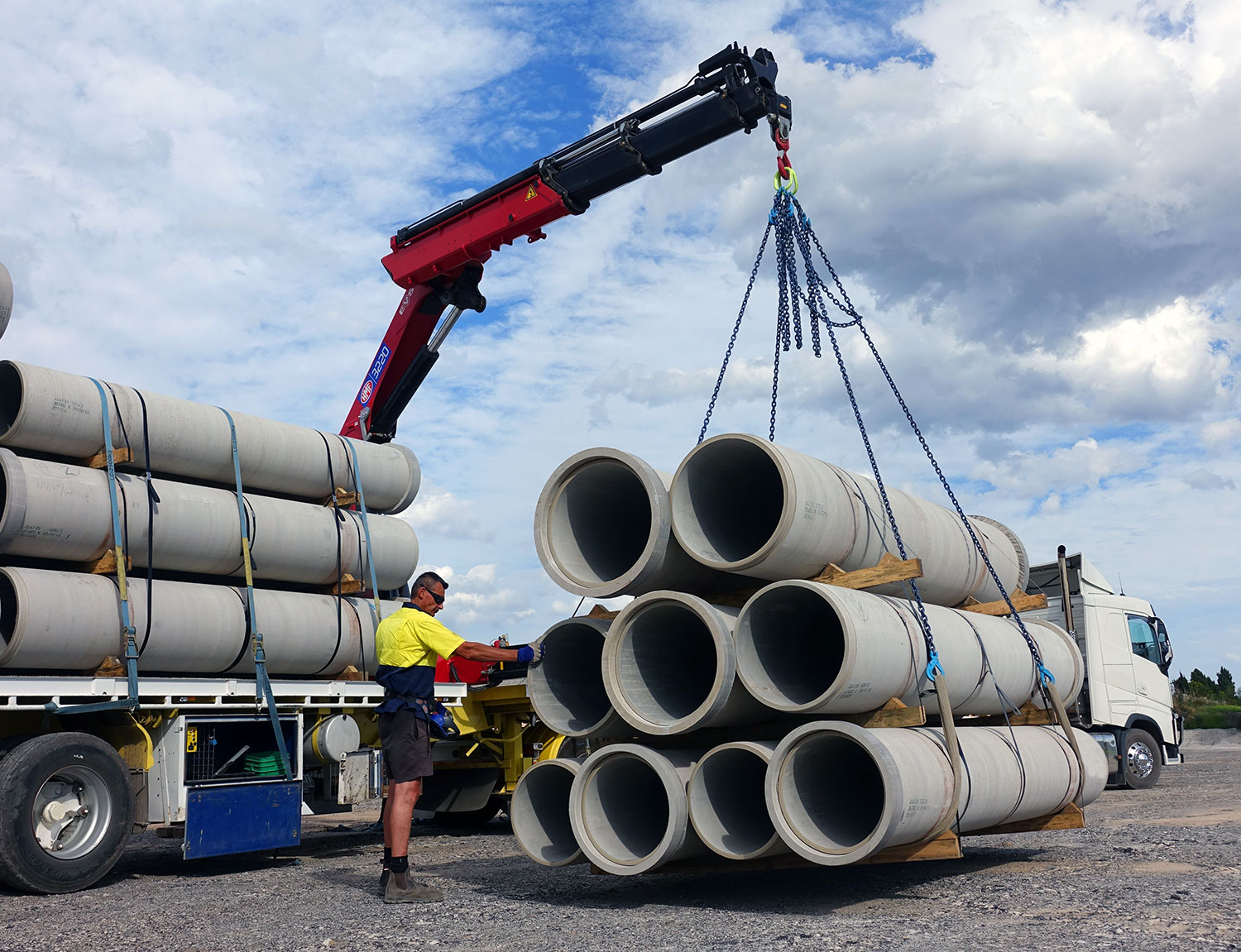
A loader crane fitted to a construction truck needs to do two things at once. It needs to lift the material at hand and leave enough payload for the trip to still make sense. Buyers tend to focus on the first part and treat the second as an afterthought, which is how you end up with a crane that looks capable on paper but eats into what the truck can legally carry.
The tonne-metre rating only tells part of that story, and only once it’s matched properly to the boom configuration and the reach the job actually demands. Get that wrong, and you’ve bought a crane that either can’t get to the load or spends most of its working life doing far less than it’s rated for.
What is a Loader Crane and How Does It Work on a Construction Truck?
A loader crane, also called a vehicle loading crane or VLC, is a hydraulic crane mounted to a standard truck chassis, most commonly in a knuckle boom configuration. Unlike a mobile crane, where the crane and vehicle are a single integrated unit, a loader crane and the truck it sits on are two separate components. The truck supplies the hydraulic power through a power take-off connected to its engine, and the crane uses that power to extend, slew and lift.
This separation is what makes loader cranes practical for construction material delivery in the first place. The truck handles transport between sites, and the crane handles self-loading and unloading at each end, without needing a second vehicle or a hired mobile crane standing by. For a business running regular deliveries of structural steel, precast panels or general building supplies, that self-sufficiency is the whole point of specifying a crane truck rather than a flatbed with no lifting capability at all.
Knuckle boom design, where the arm folds at a mid-point joint rather than telescoping out in a straight line, is the dominant configuration in the Australian vehicle loading crane market. It stows compactly against the truck when not in use and suits the tighter access many Australian construction sites present, particularly inner-city infill work and confined lay-down areas.
What Does Tonne-Metre Mean And How Should It Factor Into Crane Selection?
Every loader crane is rated in tonne-metres, usually shortened to tm. Tonne-metre is load multiplied by horizontal reach, so a crane rated at 10 tm can lift roughly one tonne at ten metres of reach, or two tonnes at five metres, and so on down the curve. That figure is what defines a crane’s size category, but it’s worth being precise about what it actually tells you.
A TM rating on its own won’t tell you what the crane can actually lift at the reach your job needs. That’s what the load chart is for. A crane that technically qualifies on its headline TM figure can still disappoint on site if nobody’s checked what it lifts at the distance that matters. The TM rating helps narrow down a size category. After that, it’s the load chart for the specific model that decides whether it’s the right crane, not the number on the spec sheet.
HMF’s range spans three broad categories. Small cranes sit between 3 and 9 tm, medium cranes between 10 and 28 tm, and large cranes between 32 and 95 tm. Where a particular model sits within those bands, and how its lifting capacity changes across its hydraulic reach, depends on the individual model’s load chart rather than the category alone.
How Does Crane Tare Weight Affect Your Truck’s Payload?
Tare weight is the crane’s weight once it’s bolted to the chassis, and every kilogram comes directly out of the truck’s legal payload under its Gross Vehicle Mass rating. This is the trade-off that gets underweighted in a lot of buying decisions, because a heavier crane with a higher TM rating can look like the safer, more capable choice, right up until the driver realises there’s meaningfully less GVM left over for the actual freight.
The more useful question is what’s the lightest crane that comfortably covers your typical lift at the reach you actually use, not the biggest one that will physically fit. A crane specified with headroom well beyond typical job requirements carries weight you never use on every trip. Danish-engineered cranes built with high-tensile steel are designed specifically to keep tare weight down relative to lifting capacity, which is one reason tare weight is worth asking about model by model rather than assuming all cranes in a given tm category weigh roughly the same. HMF publishes tare weight figures for each model, and it’s worth checking the exact figure for the specific crane you’re considering against your truck’s remaining GVM allowance, rather than working from a size category alone.
Chain of Responsibility obligations under the Heavy Vehicle National Law mean this isn’t just an efficiency question. Operators, and in some circumstances the parties who specify or load the vehicle, share legal responsibility for a truck that exceeds its GVM. A crane specified without checking its effect on available payload can become a compliance problem well before it becomes an operational one.
Why Do Knuckle Boom Cranes Dominate Construction Delivery Work?
Knuckle boom cranes fold at a mid-arm joint and pack down to a compact stowed footprint, which is why they dominate installations on Australian construction and delivery trucks working in confined or urban sites. When a truck needs to manoeuvre into tight lay-down areas, park close to a build, and still have clearance to swing the boom safely, the compact stowed size and flexible working envelope make the knuckle boom the practical default for this kind of work.
Larger knuckle boom cranes in HMF’s range also offer continuous slew, closing much of the gap that used to favour other boom designs on jobs requiring extended rotation.
Which Loader Crane Capacity Class Suits Construction Material Delivery on Your Truck?
Matching a capacity class to a truck starts with the truck’s GVM and what the tray, tools, and typical freight already account for, then moves to the individual load chart for the crane models under consideration.
Small cranes, in the 3 to 9 tm range, suit lighter construction materials and general freight on smaller rigid trucks where minimising tare weight matters most relative to the truck’s total capacity. This is also the category where the licensing question becomes relevant: cranes with a lifting capacity over 10 tm require a High Risk Work Licence to operate, so the largest models in this category sit just under that threshold. Whether a specific model falls under or over the 10 tm threshold can depend on its configuration, so don’t treat this as a blanket assumption for every crane described as “small”; check the individual model’s rated capacity directly.
Medium cranes, from 10 to 28 tm, cover most general construction and freight work where the truck has more GVM headroom, and the lifting task is more varied, from structural components to palletised material.
Large cranes, from 32 to 95 tm, are built for the heaviest lifting tasks on larger trucks, typically in infrastructure, utilities or heavy civil work rather than general delivery rounds, and this is where features like an optional Electronic Vehicle Stability upgrade become genuinely relevant to stability at extended reach and full capacity.
What Australian Compliance Standards Apply to Loader Cranes?
Vehicle loading cranes operating in Australia fall under AS 1418.11, the Australian Standard covering the design of vehicle loading cranes, alongside AS 2550.11, which addresses their safe use in practice. Compliance under these standards applies regardless of where the crane was manufactured, so a Danish-engineered crane sold in Australia still needs to meet the same design and safe-use requirements as any locally built equivalent.
In practical terms, this covers how the crane is designed and certified, how it’s inspected before it goes into service, and what documentation, including load chart information, needs to be available to the operator. Work Health and Safety obligations sit alongside these standards rather than replacing them, and installation itself is governed separately under Vehicle Standards Bulletin 6, the national code of practice for heavy vehicle modifications administered by the National Heavy Vehicle Regulator.
This is general information rather than a substitute for direct advice. GVM limits, Chain of Responsibility obligations, and specific compliance requirements can vary by state and truck class, so confirm the current requirements for your circumstances with the relevant state transport authority or a certified installer before committing to a purchase.
What Should You Check on the Hydraulics Before Choosing a Crane?
The crane’s hydraulic system must be compatible with what the truck can supply, so check the power take-off connection, the oil flow rate the crane requires, and how that lines up with the truck’s hydraulic capacity. Load sensing pumps, standard on modern HMF cranes, help here by adjusting hydraulic output to match the task rather than running at a fixed rate regardless of load, which reduces unnecessary wear on both the crane and the truck’s chassis and deck over time.
It’s also worth noting that hydraulic oil and engine oil are entirely different systems. Servicing schedules, oil types, and maintenance intervals for the crane’s hydraulic circuit are separate from anything to do with the truck’s engine, and treating them as interchangeable is a common, avoidable mistake.
Where to Go Next
The next decision usually needs more specific detail than a hub page can responsibly cover. If payload is the sticking point, the next step is confirming exact tare weight against your truck’s remaining GVM for the specific model you’re considering. If compliance is the open question, HMF Australia can talk you through what AS 1418.11 and AS 2550.11 require for certification and inspection in more detail than is useful here.
If you’re still narrowing down a capacity class or comparing specific models against a load chart, that’s not something worth guessing at from a hub page. HMF Australia can match a specific model and configuration to your truck and your typical lifting task, and talk you through exact tare weight, load chart figures and compliance requirements for your circumstances. Get in touch with the team to work through it properly before you commit to a crane.